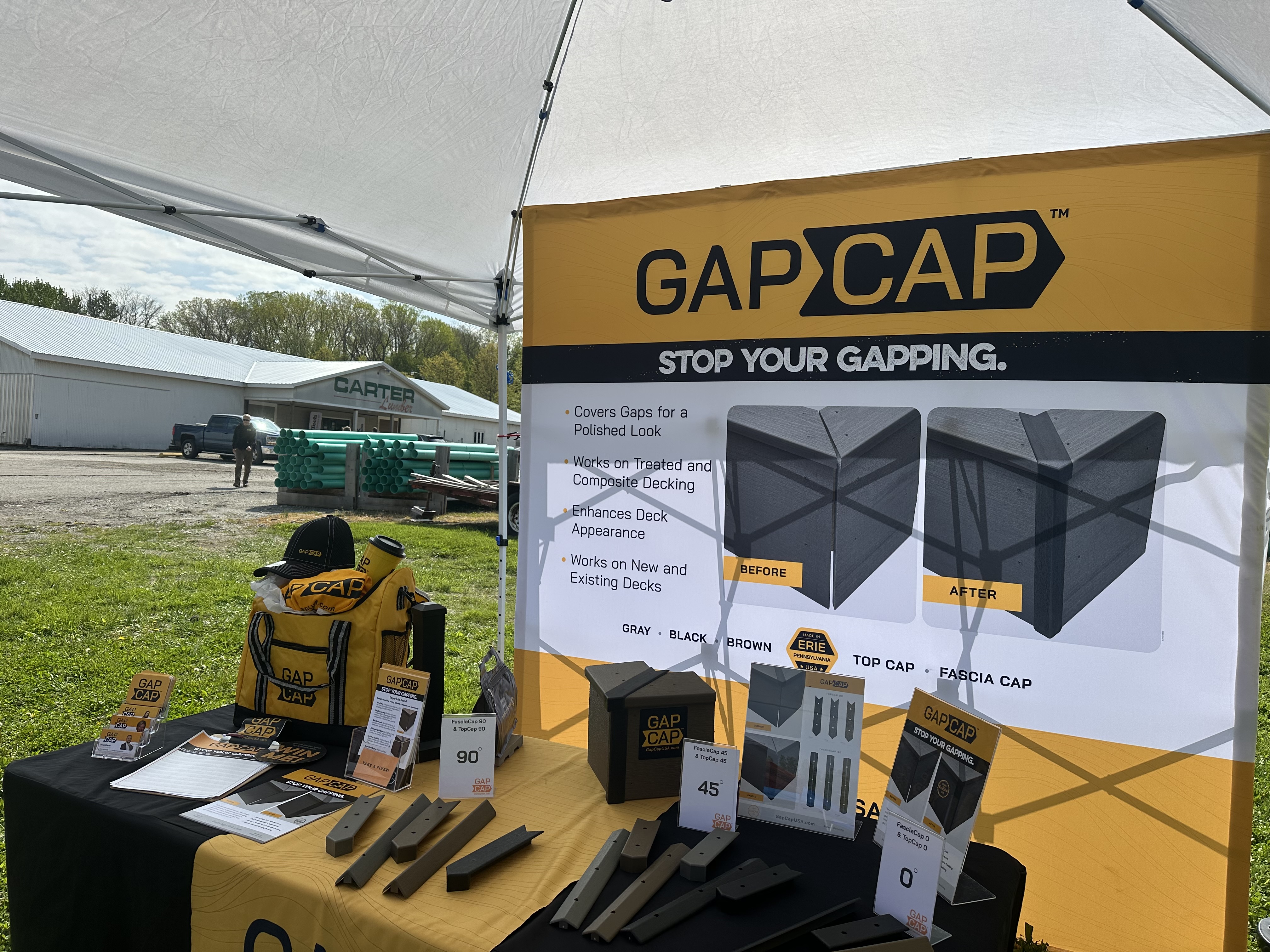
The GAPCAP™ Story
From a garage prototype to a patented product: how a 16-year deck builder's frustration with corner gaps became GAPCAP™.

Composite and treated deck boards expand and contract with the seasons. In summer, a perfectly mitered 45-degree corner looks flawless. Then temperatures drop, the boards shrink — sometimes nearly half an inch on a 20-foot board — and the corners open. The gaps collect water and debris. Customers call. Until recently, there was nothing a contractor could do about it.
Doug Bierer knew this problem better than most. He'd been building decks for over 16 years — beautiful, high-end ones — and he ran into the same issue on every job.
For more than five years, Doug and his wife and business partner, Andrea, went looking for a fix. They asked suppliers. They asked a major national decking brand directly. At one seminar, a contractor asked that brand's rep what the company was doing about the gap problem. The answer: educate your customers, tell them to live with it. When Doug pushed further, the rep admitted they couldn't change physics — and weren't interested in trying.
That was the moment Doug decided he'd build the solution himself.
Starting in the garage with wood and metal, he shaped an idea — a small piece that could sit over a mitered corner, let the boards beneath expand and contract freely, and hide the gap for good. He called it GapCap. DBC Remodeling, the deck-building company Doug and Andrea had run for over 16 years, became the first proving ground, field-testing prototypes through a real Erie winter.
The idea might have stayed a garage project if not for a conversation at church. Dean Lewis, an engineering professor at Penn State Behrend and a friend of Doug and Andrea's, mentioned his senior engineering program — and Doug mentioned the idea he didn't know what to do with. That led to Ben Fahrney, a Penn State Behrend senior who, in three weeks, turned Doug's garage prototype into a fully 3D-rendered, 3D-printed design.
Gannon University's Makerspace took the concept through a second round of refinement. And when Doug and Andrea needed to know how the product would hold up over time, a chance meeting at their church coffee shop introduced them to Mike Alabran, owner of PSN Labs — a testing and certification lab that, coincidentally, used to run tests for a major national decking brand. PSN Labs designed the injection molds, ran the first production batches, and tested the material at its most brittle point (18°F) with a ball-peen hammer. It didn't crack.
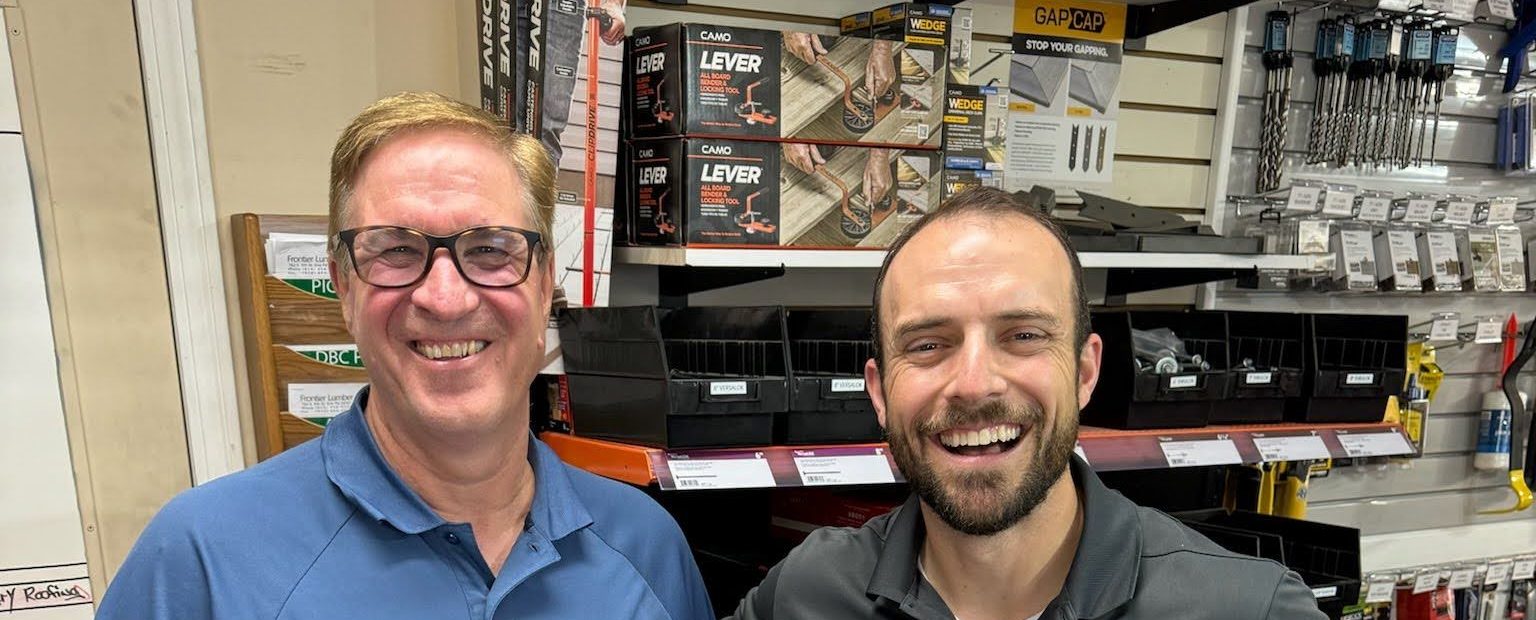
With a certified product in hand, GapCap launched with two items, TopCap90 and FasciaCap90, made from the same composite material as the deck boards themselves. Jeff at Frontier Lumber was the first retailer to say yes. A chance meeting at a Frontier home show connected GapCap with Watson Marketing, a distributor representative who connects GapCap with distributors across the country. And Carter Lumber's Harbor Creek location became one of the brand's most enthusiastic champions, helping GapCap land in stores across the region.
As of 2026, GapCap holds full patent approval on both products. Installation takes just a few minutes per corner, down from the time contractors used to spend trying to perfect a mitered corner that would just open up again anyway. No more callbacks. No more gaps.
Frequently Asked Questions
GAPCAP™ was founded by Andrea and Doug Bierer. Doug built decks for over 16 years through their company, DBC Remodeling, before creating GAPCAP™ to solve the corner-gap problem he ran into on every job.
Composite and treated deck boards expand and contract with the seasons, opening unsightly gaps at mitered corners that collect water and debris. GAPCAP™ covers the corner while letting the boards beneath move freely — hiding the gap for good.
GAPCAP™ is an American-made product, designed and manufactured in the USA by a family-run company based in Erie, Pennsylvania.
Just a few minutes per corner — down from the time contractors used to spend perfecting a mitered corner that would just open up again anyway.